
LinkedIn Auto Engagement for Sales Teams: Stay Visible Without Looking Spammy

Most sales reps already know they should comment more on LinkedIn. Then the day fills up with calls, and the feed never gets opened.
That is the real problem behind LinkedIn auto engagement. It is not a trick to game the platform. It is the question busy sellers ask when they want to stay visible to buyers without living in the app—and without sounding like a template.
LinkedIn is still a professional network. People notice when a comment could have been left by anyone, on any post, in any industry. They also notice when you actually add something. The difference is what this article is about.
Let's break it down.
What LinkedIn auto engagement is (and what it is not)
In plain terms, LinkedIn auto engagement is any system that helps you like or comment on other people's posts on a cadence, so you show up in the right conversations even when you cannot scroll for an hour.
It is not the same as blasting the whole feed. It is not an engagement pod. And it is not a substitute for having something to say.
LinkedIn's Social Selling Index still describes social selling as four behaviors: professional brand, the right people, engaging with insights, and relationships. Comments sit in that third bucket. A useful comment can put your name in front of a buyer who never saw your original post. A hollow one does the opposite: it trains people to skip you.
LinkedIn's own Professional Community Policies are blunt about spam and fake heat. They ask members to create original, relevant content, respond authentically, and not do things to artificially inflate engagement—including agreeing in advance to like or reshare each other's posts. That is the bar. Anything you build around comments should look like a person who read the post, not a quota.
What makes comments look spammy
If you have ever muted someone, you already know the pattern.
Weak: "Great post! Totally agree. 🔥"
Better: "The point on stakeholder alignment is the one we keep seeing in late-stage deals. The champion is interested, but nobody owns implementation. How are you mapping that before legal gets involved?"
The first line could sit under a post about cloud security, hiring, or a product launch. The second could only sit under that post. That is the whole test.
Other tells that read as low-effort:
The same two sentences recycled across twenty posts
Commenting on everyone, including people you would never take a meeting with
A sudden jump from silence to a huge daily volume
Comments that never mention a specific claim, example, or question from the original post
Coordinated groups that like and comment on cue
Forbes has covered how LinkedIn has gone after engagement pods—coordinated likes and comments that exist to manufacture reach. The lesson for a sales team is simple: borrowed heat is not social selling. If the only reason you commented is to be seen, people can usually tell.
Generic AI language is getting cheaper to spot, too. In 2026 LinkedIn's product leadership has been public about pushing back on low-quality generated text in the feed and in comments, including member reporting and defenses against automated comment attempts. SiliconANGLE's reporting on that shift quotes Chief Product Officer Hari Srinivasan: people come to LinkedIn to connect with real people and share real perspectives. If a comment sounds like it was written for "a professional audience" and no one in particular, it is already behind.
For how a specific comment still outperforms a vague one, see SocialSense's How to Maximize LinkedIn Engagement with Targeted Comments: A SocialSense Case Study.
A safer way for sales teams to stay visible
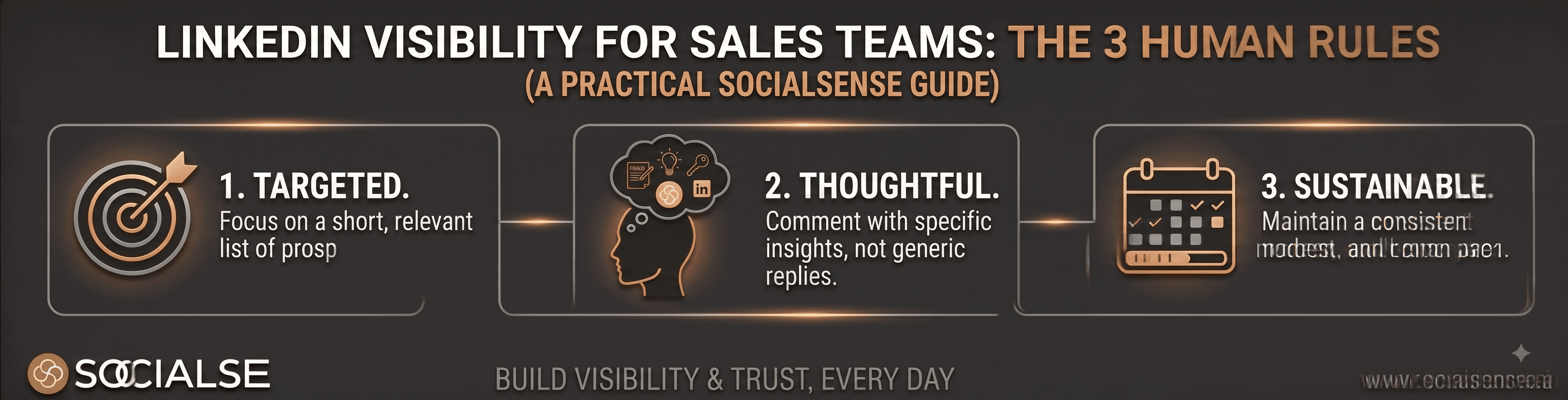
Treat comments as a short daily habit aimed at a short list of people, not as a volume contest.
A working sequence looks like this:
Name who matters. Prospects, customers, partners, and a few operators whose posts your buyers already read.
Decide the depth. Some names only need a like. Others deserve a real sentence.
Cap the day. A modest, steady pace looks more human than a spike.
Require a hook from the post. One detail, one disagreement, one question.
Read the log. If a line would embarrass you on a call, it should not go out.
That last step is the split between review and autopilot. Autopilot is "I never look." Review is "the system drafts or queues; I still own what appears under my name." The same standard applies if a sales tool helps you draft.
If you want a system that only acts on people you pick, with a daily cap, a chosen tone, and a history you can undo, that is the job of SocialSense Auto Engagement. It is there so consistency does not depend on willpower. It is not there so you can ignore the words that go out under your photo.
Picking the right people first is half the work. SocialSense's How to Track and Engage Key Connections on LinkedIn for Better Networking with SocialSense is the companion for that targeting problem.
Approach | How it looks to a buyer | Typical risk |
Scroll when you remember | Honest, but invisible for weeks | Insights pillar stalls |
Comment on anyone, high volume | Busy, often generic | Looks like a script |
Shortlist + specific comments + a daily cap | Present, relevant | Takes a little setup |
Queue or drafts with a log you actually open | Consistent, still yours | Fine if you edit weak lines |
How to set this up without sounding like a machine
Keep the operating rules small enough that a rep will follow them on a full pipeline week.
Who: ten to thirty names you would actually sell to or learn from—not a dump of your entire network.
What: like-only for people you are only tracking; a real comment when the post is about a problem you know from deals. Skip birthday-style filler unless you would say it in person.
How it should read: a sentence you would say on a call. If you would not say "This resonates so much, thanks for sharing," do not publish it.
When: same window most days, not a burst at midnight and nothing until Friday. LinkedIn's SSI framing is a rolling picture of habits, not a one-week sprint. You can check the official breakdown any time on the SSI dashboard. For the four pillars in one place, see How to Improve Your LinkedIn SSI Score: The Complete 2026 Guide.
Voice: if AI helps with a first line, add one field detail. That is the same rule as drafting posts. SocialSense's AI LinkedIn Assistant: How Sales Teams Can Build Personal Brand Without Losing Their Voice is the longer version of that idea.
What to watch: replies to your comments, profile views from the right titles, and whether you would still send the line. Impressions on someone else's post are not the goal. Being useful in their thread is.
Frequently Asked Questions
Does LinkedIn auto engagement look spammy? It looks spammy when the comment could fit any post, the volume jumps overnight, or you are showing up under people you have no reason to know. It looks normal when you comment on a short list, reference something specific, and keep a pace you could explain to a customer.
Can I automate LinkedIn comments safely? "Safely" here means: stay inside LinkedIn's rules, do not manufacture engagement, and do not publish lines you have not stood behind. Use a cap, choose the people, prefer like-only when a comment would be empty, and open the activity log. You are still the author.
Should I comment on every prospect post? No. Comment when you have a real add. A like is enough when you have nothing to say. Empty comments train the feed—and the buyer—to ignore you.
Is a like as useful as a comment? A like is a nod. A comment is a public introduction. LinkedIn's social selling language puts more weight on engaging with insights than on lurking. Likes alone will not carry that.
Will this replace posting? No. Comments keep you in other people's audiences. Your own posts still have to earn "see more." Use both. Comments without a point of view is just presence. Posts without comments is just broadcasting.
Final thoughts: be findable, not noisy
Sales teams do not lose deals because they failed to leave fifty comments. They lose the quiet weeks when the right buyer posted and nobody from your team was in the thread.
The fix is not more noise. It is a short list, a human sentence, a daily cap, and a habit of reading what went out under your name.
If you want help running that cadence—people you choose, limits you set, a log you can undo—look at SocialSense Auto Engagement. The standard does not change: if you would not say it on a call, do not leave it on the post.
TL;DR
LinkedIn auto engagement only works if comments stay specific, capped, and reviewed.
Comment on a short list of real buyers and operators, not the whole feed.
Skip generic lines; reference one claim, example, or question from the post.
Prefer a like when you have nothing useful to add.
Keep a daily cap and open the activity log before you trust the cadence.
Follow LinkedIn's own rules: authentic replies, no manufactured engagement.
For more information, contact SocialSense at contact@socialsense.ai

From LinkedIn Comment to Meeting: How to Follow Up Without Being Awkward

Kaushal Surana

How to Write a LinkedIn Connection Request That Isn’t a Pitch
Kaushal Surana
LinkedIn Auto Engagement for Sales Teams: Stay Visible Without Looking Spammy
Kaushal Surana

How to Write High-Performing LinkedIn Posts
Kaushal Surana
LinkedIn Content Strategy for B2B Growth: A Repeatable System (Not Random Posting)
Kaushal Surana

AI LinkedIn Assistant: How Sales Teams Can Build Personal Brand Without Losing Their Voice
Kaushal Surana