LinkedIn Content Strategy for B2B Growth: A Repeatable System (Not Random Posting)
If your current LinkedIn strategy amounts to "post when you feel inspired and hope it lands," you're in good company. I've seen plenty of sharp founders, consultants, and B2B marketers stick with it for months straight — three likes, one obligatory comment from a coworker, and nothing in the pipeline to show for it. It's frustrating, and it's easy to blame the platform. Usually, though, LinkedIn isn't the problem. The strategy is.
There's a reason LinkedIn keeps coming up as one of the strongest B2B marketing channels: it's simply where the buyers, operators, and decision-makers already are. The platform now counts more than 1 billion members worldwide, and unlike some other networks, its whole ecosystem is built around professional identity and business conversation, not entertainment. If you sell to other businesses, that's a big deal.
The numbers back this up too. Per LinkedIn's own 2026 guidance, brands that post at least weekly get roughly 2x more engagement than less-frequent posters, and posts from employees typically outperform company page posts by about the same margin. Makes sense — people tend to trust people more than they trust logos. So if your posts are getting crickets, don't write off the channel just yet. You probably just need a better system behind it.
Let's build one.
Crafting the Right LinkedIn Content Mix for Engagement That Actually Compounds
Here's the blunt version: if every post is a product pitch, your audience starts mentally muting you.
LinkedIn engagement comes from variety. Think of your content like a dinner party — if you only talk about yourself, people find a reason to leave early. Share stories, teach useful ideas, ask real questions, and mention what you offer occasionally instead of constantly, and people actually lean in.
A strong LinkedIn content strategy usually balances four types of content.
1. Thought leadership
This is where you show how you think — not vague "leadership matters" posts, but real, specific perspective. A few examples:
"Why most sales teams are measuring the wrong LinkedIn metrics"
"The mistake B2B founders make when hiring their first marketer"
"What 50 discovery calls taught us about CFO objections"
Thought leadership works best when it carries original experience, real data, or a genuine opinion — data-driven B2B playbooks specifically call out original data, proprietary frameworks, and contrarian angles as the content types that actually drive pipeline, while generic "tips" posts tend to collect likes and deliver very little else. Your best posts, in other words, aren't always the ones with the most likes. They're the ones that spark a qualified conversation in your DMs.
2. Storytelling
People remember stories faster than they remember frameworks.
Instead of writing "consistency matters on LinkedIn," tell the story of a founder who posted daily for 30 days, got nowhere, then switched from generic tips to customer-backed insight and started getting inbound DMs within a week.
A storytelling post usually holds up better with this shape:
The problem
The moment of realization
The lesson
The practical takeaway
Simple. Human. Memorable.
3. Educational content
This is your "save-worthy" material — how-to posts, carousels, checklists, teardowns, trend explanations. LinkedIn benchmark research consistently shows that native document carousels, multi-image posts, and video outperform plain text updates on engagement. In plain English: visual, skimmable content keeps people on the post longer, and dwell time is one of the signals the feed rewards.
A practical B2B content mix might look like this:
Content Type | Purpose | Example |
Document carousel | Teach a framework | "7 LinkedIn Posts That Generate Sales Calls" |
Short video | Build trust quickly | 60-second take on a market trend |
Text post | Share a story or opinion | "The worst LinkedIn advice I ever followed" |
Poll | Start conversation | "What's your biggest LinkedIn challenge?" |
Case study | Build proof | "How one post led to 12 qualified DMs" |
4. Engagement triggers
Polls, questions, "agree or disagree?" prompts, and specific CTAs pull people into the conversation — as long as you skip lazy engagement bait.
Weak: "Thoughts?"
Or better: "If you're selling to mid-market SaaS companies, what's actually working better for you right now — LinkedIn content, outbound email, or partner referrals?" Specific questions tend to get specific answers back.
A ratio a lot of B2B teams lean on as a starting point is 40/40/20:
40% expertise — frameworks, how-tos, lessons, original insight
40% engagement — stories, questions, opinions, anything community-driven
20% promotional — offers, demos, product updates, customer proof
If your feed is currently 80% product talk, that's not really a content strategy — it's a billboard.
One thing worth stealing: don't create from scratch every time, repurpose what you've already got. A webinar can turn into five carousels. A sales call objection can become a text post. A customer win can become a case study. This is actually where a tool like SocialSense.ai's PostPilot earns its place — it takes your existing experiences, files, articles, and even voice notes and turns them into LinkedIn-ready posts, so you're not staring at a blank page every morning.
Leveraging LinkedIn for Lead Generation With Social Selling Content
A simple working definition first:
Social selling is the process of building trust, creating useful conversations, and turning those conversations into business opportunities — without pitching strangers like a robot.
That's really the whole point of it. LinkedIn lead generation works best when it feels like you're building a relationship, not scraping a list. It helps to think of it as a loop rather than a funnel: build authority, listen strategically, engage meaningfully, nurture the relationship, and let conversion happen on its own. Here's roughly how that unfolds across three stages.
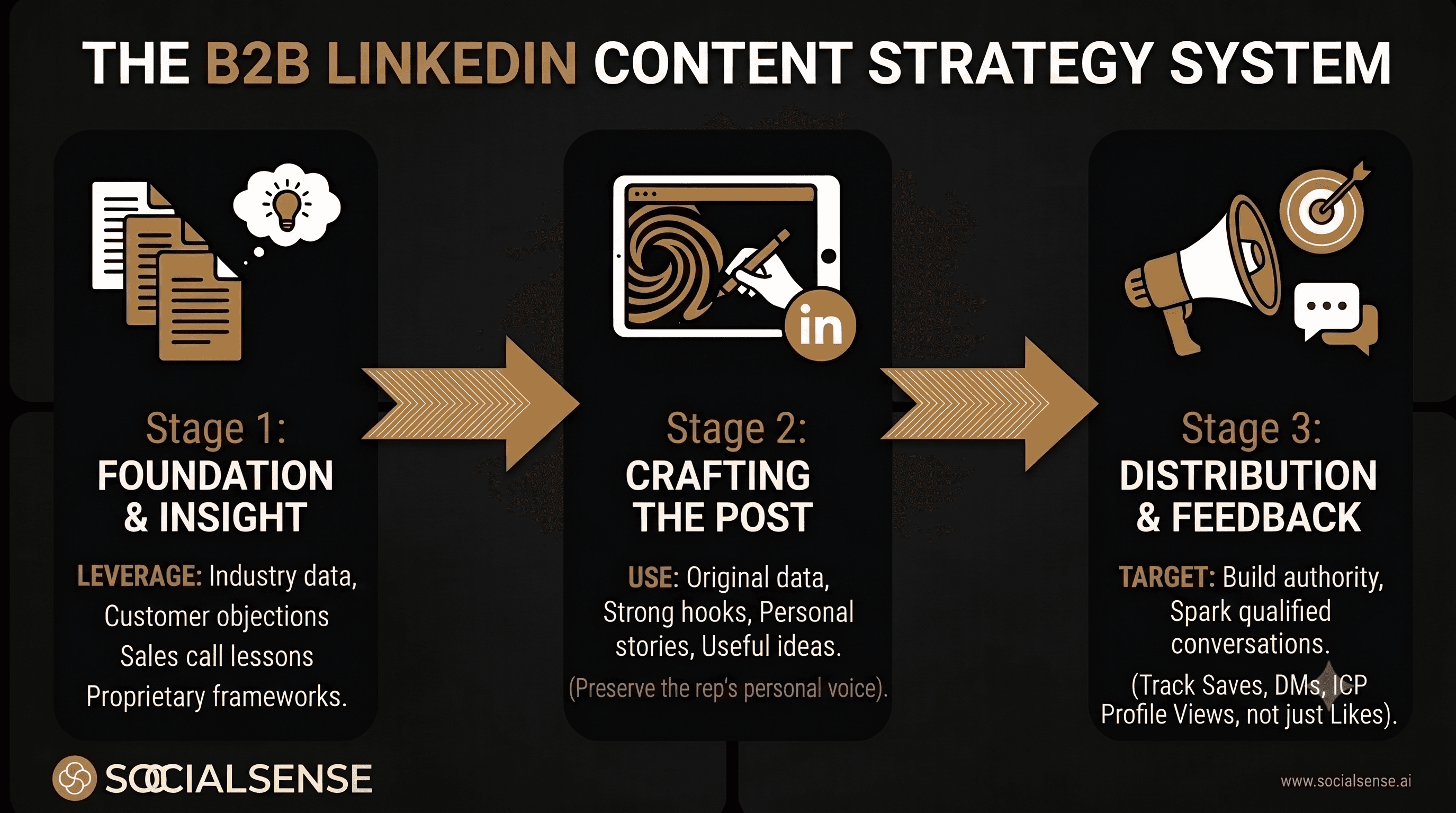
Stage 1: Build the relationship before you need it
Most people get this order backwards — connect first, pitch immediately, then disappear when it doesn't work. Try flipping it: get visible to the right people before you need anything from them. That means, daily:
Leaving thoughtful comments on posts from target buyers, partners, and industry voices
Responding when people engage with what you post
Sending connection requests with actual context, not a copy-pasted line
Watching for buying signals — hiring posts, funding announcements, tool complaints, expansion news
A genuinely good comment can outperform a mediocre post. So if your ideal customer is venting about sales productivity, skip "We help with that, book a demo" and try something closer to:
"We've seen this happen when teams keep adding tools without fixing the workflow underneath. What's helped some teams is mapping exactly where reps lose time — research, outreach, follow-up. Is your bottleneck more process or more adoption?"
That reads as someone actually joining the conversation, not pitching at it — and people notice the difference right away.
Stage 2: Create content that sells without sounding like it's selling
The best social selling content leaves your buyer thinking "okay, this person actually gets my problem." A few things that do that well:
Case studies with real before-and-after detail
Customer objections, laid out honestly, along with how you handle them
Behind-the-scenes breakdowns of your process
Lessons pulled from sales calls or implementation projects
Comparison posts that help buyers make smarter decisions
Here's a soft-sell structure worth adapting:
"A VP of Sales told us their team was posting on LinkedIn but not generating conversations.
The issue wasn't effort. It was that every post sounded like a product brochure.
We rebuilt their content around founder stories, customer objections, and practical frameworks. Within 45 days, their team had more relevant profile views, more DMs, and warmer sales conversations.
Lesson: buyers don't engage with your product first. They engage with your point of view."
Notice the product is present in that post, but it isn't shouting.
Stage 3: Use LinkedIn's own features to accelerate what's already working
Organic and paid don't have to compete — they work better as teammates. A sensible workflow looks like:
Publish organically
Track which posts earn saves, comments, profile views, and DMs
Turn the winners into sponsored content
Use LinkedIn's native tools to capture the resulting demand
For more targeted lead generation, that means leaning on:
LinkedIn Sales Navigator for account targeting and prospect research
LinkedIn Lead Gen Forms to cut friction on paid campaigns
LinkedIn Events for webinars, roundtables, and community-based demand generation
Boost what's already proven — don't pay to promote a message that hasn't earned organic traction yet. Paid amplifies whatever signal you already have, good or bad.
Measurement matters here too. Likes are nice, but they don't pay invoices. LinkedIn's own guidance for B2B marketers points toward tracking quality actions over surface engagement — things like profile views, saves, and direct messages rather than raw impressions.
Vanity Metrics | Better Revenue Signals |
Impressions | ICP profile views |
Likes | Saves and shares |
Follower count | Inbound connection requests from buyers |
Generic comments | Qualified DMs |
Post reach | Meetings booked and pipeline influenced |
If your content is getting fewer likes but more sales conversations, you're winning — even if the analytics dashboard doesn't make that obvious at a glance.
Using AI to Streamline Your LinkedIn Content Strategy
AI won't fix a boring point of view. It can, however, help you execute a good one much faster.
The best use of AI here removes friction, not personality. It's closer to a sous-chef than a ghostwriter — it can chop the vegetables and organize the ingredients, but you're still the one deciding what the dish tastes like. And that distinction matters — guidance built around AI-assisted LinkedIn strategy is pretty blunt about it: generic AI prompts produce generic content. The results that actually hold up come from pairing AI with your own data, your own frameworks, and your own stories — not from handing it the wheel entirely.
A few ways this plays out in practice:
Idea generation. Something like: "Give me 20 LinkedIn post ideas for a B2B sales consultant targeting SaaS founders — focused on sales process mistakes, founder-led selling, and pipeline quality." Then go through and keep only the ones that actually match what you've lived through. Not all 20 will.
Hooks and headlines. Your first two lines decide whether anyone clicks "see more" at all. Ask for ten variations, then pick whichever one actually sounds like you'd say it.
Weak: "LinkedIn is important for B2B growth."
Better: "Most B2B founders don't have a LinkedIn problem. They have a point-of-view problem."
Repurposing. A single customer interview can turn into 3 text posts, a carousel, a founder story, a case study, five sales enablement snippets, and ten comment prompts — more mileage than most people realize is sitting in one conversation.. This is where a platform like SocialSense.ai's PostPilot earns its keep — it can transform your company information, LinkedIn profile, files, ideas, articles, voice notes, and knowledge base into personalized LinkedIn content, and Content Workflow lets you review, approve, and schedule what comes out of it.
Use AI for personalization. For outreach, AI can help summarize a prospect's background, recent activity, and likely conversation angles. SocialSense.ai's My Contacts feature, for instance, surfaces AI insights on your LinkedIn connections — work experience, recent activity, and personalized conversation starters. "Hey, I saw we're both connected to Sarah" stopped being personalization a while ago; it's table stakes now.
The human part still comes from your judgment, your stories, your opinions, and your empathy. AI just buys you more time to actually use them.
Advanced LinkedIn Marketing Tips to Stand Out Right Now
Once the foundation is in place, small improvements compound quickly. Here's what I'd prioritize for more reach, trust, and pipeline.
1. Treat your first two lines like a headline
People scroll fast. Your opening line has exactly one job: earn the next second. Strong hooks tend to sound like:
"We analyzed 100 sales calls. One pattern kept showing up."
"Your company page is not your best LinkedIn asset."
"The post that got the most likes generated zero leads."
Curiosity beats cleverness almost every time.
2. Make document carousels part of your weekly rhythm
PDF carousels work because they create dwell time — they invite people to swipe, pause, and save. Use them for frameworks, checklists, step-by-step processes, data breakdowns, mistake lists, and before-and-after examples. Keep slides clean: one idea per slide, big text, a clear story arc.
3. Design video for silent viewing
Roughly 80% of LinkedIn video is watched without sound, which makes captions and on-screen text non-negotiable. If your video only works with the audio on, it doesn't really work for LinkedIn.
4. Build an employee-led content engine
Your company page is probably not your strongest growth channel — your executives, founders, sellers, and subject-matter experts usually carry more trust than the brand account does. Help them post, with a simple internal system:
Weekly topic prompts
Approved customer stories
Content templates
Commenting guidelines
Shared analytics review
SocialSense.ai's Analytics can help here by giving a complete view of LinkedIn performance — SSI score, engagement, audience growth, and post performance in one place. And if you're tracking your Social Selling Index specifically, LinkedIn has its own SSI tool that shows how you're doing on building your professional brand, finding the right people, sharing relevant insights, and building relationships.
5. Run a 90-day sprint instead of just winging it
Random posting gets you random results. A structure worth borrowing for the next 90 days:
3–4 posts published per week
10–20 meaningful comments on targeted posts, daily — this one's underrated; data-driven B2B growth guides keep flagging it as one of the highest-leverage habits people skip
5 genuinely thoughtful connection requests, daily
Review analytics every Friday
Double down on the top 3 themes each month
Turn your best organic post into a carousel, newsletter, or paid test
A simple daily checklist:
Comment on 3–5 ICP posts before posting
Publish or schedule one useful post
Reply to every meaningful comment
Check profile views and new connection requests
Start one genuine DM conversation
Save content ideas from customer calls
None of this is glamorous. Neither is going to the gym. It works for the same reason: it compounds.
6. Align LinkedIn with your broader marketing goals
Don't build LinkedIn content in a silo. If your company is pushing a new product category, your posts should educate the market around it. If sales keeps hearing the same objection, your content should address it directly. If your best customers cluster in one industry, your examples should speak to that world specifically.
LinkedIn should support your funnel, not float beside it doing its own thing.
Your Path to LinkedIn B2B Growth
A strong LinkedIn content strategy isn't about posting motivational quotes and hoping the algorithm notices you. It's a repeatable system:
Treat LinkedIn as a people-driven B2B growth channel, not a press-release feed
Mix thought leadership, storytelling, education, and soft promotion
Build social selling content that earns trust before it asks for a meeting
Use AI to scale consistency without losing your voice
Measure saves, DMs, profile views, meetings, and pipeline — not just likes
Run a focused 90-day sprint and adjust weekly
Picture a LinkedIn strategy that doesn't eat your calendar but still puts relevant buyers in your inbox — not random attention, but real conversations, warmer leads, and better sales calls. That's the actual goal here.
If you want help making the process easier, SocialSense.ai converts your experience into engaging LinkedIn content, manages your workflow, understands your contacts, and tracks performance so you can improve your SSI and social selling results over time.
Start small this week: pick three themes, write one story post, build one educational carousel, and leave a handful of thoughtful comments on the posts your buyers are already reading.
That's how momentum starts.
TL;DR
Balance thought leadership, storytelling, education, and soft promotional content — the 40/40/20 split is a solid starting ratio.
Prioritize saves, DMs, and profile views over likes when judging what's working.
Use AI tools like SocialSense.ai to execute faster without sounding generic.
Build trust through social selling — comments and context before any pitch.
Run a structured 90-day sprint (3–4 posts/week, daily commenting) instead of posting at random.
For more information, contact SocialSense at contact@socialsense.ai

How to Write a LinkedIn Connection Request That Isn’t a Pitch

Kaushal Surana

LinkedIn Auto Engagement for Sales Teams: Stay Visible Without Looking Spammy
Kaushal Surana

How to Write High-Performing LinkedIn Posts
Kaushal Surana
LinkedIn Content Strategy for B2B Growth: A Repeatable System (Not Random Posting)
Kaushal Surana

AI LinkedIn Assistant: How Sales Teams Can Build Personal Brand Without Losing Their Voice
Kaushal Surana

How to Improve Your LinkedIn SSI Score: The Complete 2026 Guide
Kaushal Surana